
Queen Victoria's Chocolate Gift Box (New Year 1900)
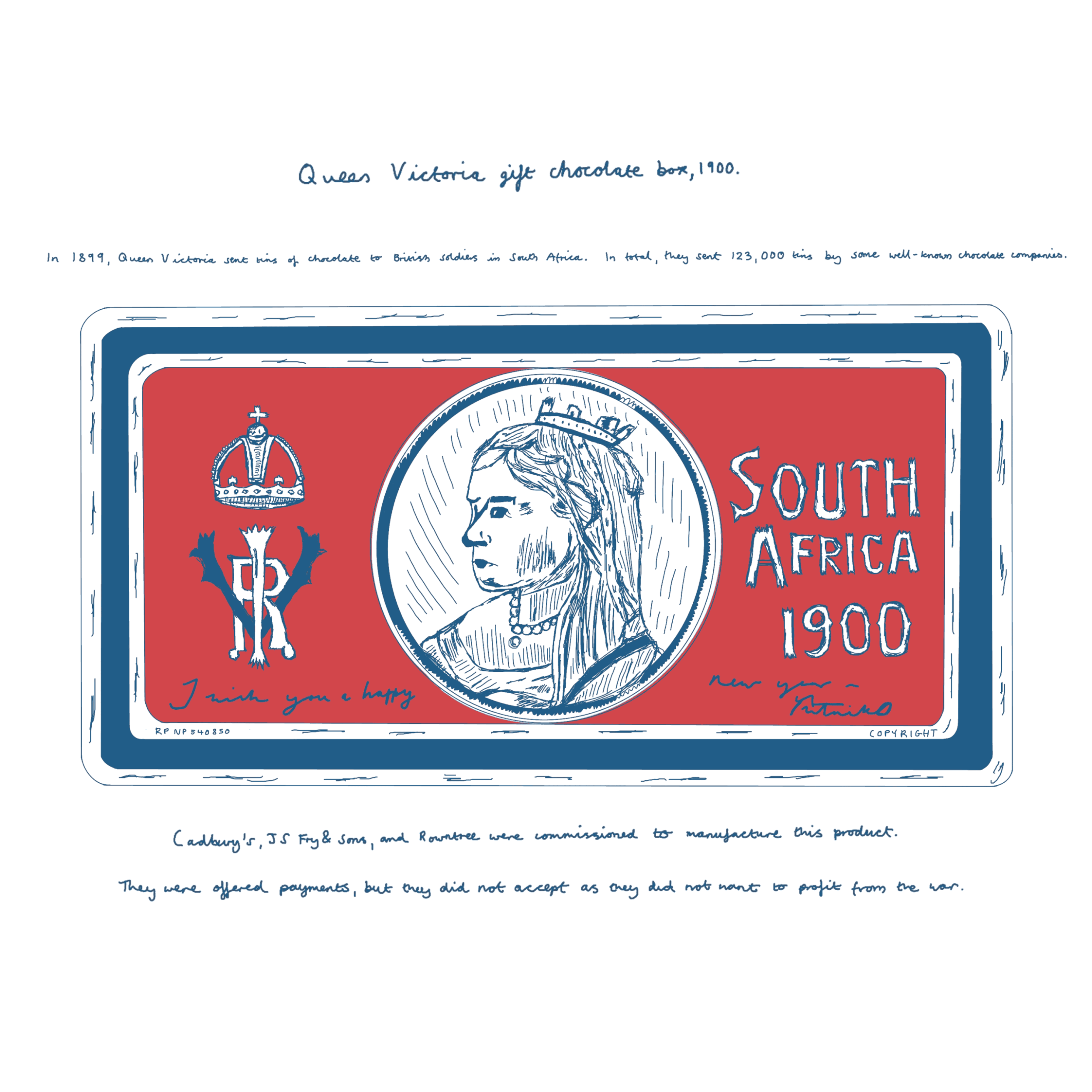
At the Soldiers of Gloucestershire Museum, each artifact tells a unique story of history, service, and sacrifice. In this installment of our Real-Life Stories Behind Our Exhibits series, we take a closer look at Queen Victoria’s Chocolate Gift Box, a remarkable piece of military history from the Second Boer War (1899-1902).
A Royal Gift to Soldiers
In 1899, as British troops faced the hardships of the Boer War in South Africa, Queen Victoria sought to send a personal token of appreciation and morale-boosting goodwill to her men. She commissioned special tin boxes of chocolate, inscribed with the words ‘South Africa 1900’ and in her own handwriting, ‘I wish you a happy New Year’.The order for the chocolates was given to Britain’s three leading chocolate manufacturers:
- J S Fry & Sons
- Cadbury Brothers Limited
- Rowntree & Company Limited
However, as Quakers, these manufacturers were opposed to war and refused payment for the order, instead choosing to donate the chocolate as a gesture of goodwill. By the end of 1900, approximately 123,000 tins had been produced and distributed to soldiers.
A Cherished Keepsake
 As a personal gift from the Queen, the chocolate tins became treasured items among soldiers. Many preserved their tins, even sending them back home for safekeeping rather than consuming the chocolate. In some cases, recipients never even untied the ribbon on the packaging. The tins became so highly valued that some soldiers willing to part with them could sell them for as much as £20—a significant sum at the time.An Army Order issued from Bloemfontein in April 1900 ensured that the tins were also forwarded to:
- Officers and soldiers who had been invalided home before receiving their gifts.
- The next of kin of those who had died in service during the war.
The Boer War and the Gloucestershire Regiment
As the war continued, more soldiers from Gloucestershire joined the fight. The 1st Battalion, The Gloucestershire Regiment had already been stationed in South Africa, and in January 1900, the 2nd Battalion arrived at Cape Town. A Volunteer Company of 124 officers and men from the 1st and 2nd Volunteer Battalions landed in March, followed by a squadron of the Royal Gloucestershire Hussars days later. The 4th Militia Battalion landed on St. Helena on 23rd April 1900, assigned to guard Boer prisoners.The 2nd Battalion joined the 6th Division under Lord Roberts, advancing into the Orange Free State and Transvaalto relieve besieged towns such as Ladysmith and Kimberley. The march was grueling, worsened by the Boer capture of British supply trains, which left the army on short rations.One soldier, Lieutenant Savage, recalled an extraordinary act of bravery during a battle at Driefontein:
“Another outstanding case was a young soldier whose name unfortunately I cannot remember. He belonged to my section. We were moving towards our objective in extended order, bullets and pom-pom shells were too frequent to be pleasant, and all the time he kept murmuring the word “Mother”. We were now drawing near to our goal and the firing intensified. The order was passed – “Fix Bayonets,” then “Charge.” I could never fathom the change which came over him. Still muttering that adorable word “Mother” he charged, sometimes using his bayonet and then his magazine, into the very thick of it as though the tradition of the “Old Slashers” depended upon him. His example brought others less daring to his side until we reached the summit of the hill and victory.”
Daily Hardships of War
For soldiers like Private Dix of the Volunteer Company, daily life was a mixture of hardship and routine. He later recalled conditions while stationed at Sanna’s Post:
“Our rations consisted of biscuits, Bully and McConnachie dried vegetables. I forget if we had a cigarette ration, but I don’t think we did; but I do remember paying 5d per 5 packet of Woodbines at Sanna’s Post. We did get a ration of Flat Black Army Cake tobacco which, when one got used to it, was really good. We also had Rum Ration twice a week in the wet season, also Lime Juice twice per week.”
The Royal Gloucestershire Hussars, meanwhile, found themselves engaged in convoy protection, raids, and skirmishes with Boer forces between 1900 and 1901. Lieutenant Altham Graham-Clarke wrote home about his experiences acquiring horses for military remounts:
“…Yesterday I went to Newberry’s the Millionaire to attach his race horses for remount purposes. Mrs N. is under suspicion and being sent to Cape Town. They have a lovely house and place all furnished by Maple of the best. I have done my business. I have got their carriage horses pulling in a gun.”
The Siege of Ladysmith
The 1st Battalion, The Gloucestershire Regiment, was involved in the Siege of Ladysmith, one of the key battles of the Boer War. Arriving in October 1899, the battalion was among British forces rapidly deployed from India to reinforce Sir George White’s troops in Natal.A few days later, the Gloucesters saw their first combat at Rietfontein, where they successfully delayed the Boers. However, on 29th October 1899, the British attack at Nicholson’s Nek failed, leading to the surrender of 450 men of the Gloucesters alongside the Royal Irish Fusiliers. The remaining Gloucesters endured four months of siege under constant bombardment from Boer artillery, including the powerful Creusot 155mm “Long Tom” gun.Finally, on 28th February 1900, British reinforcements broke through and relieved Ladysmith. Sergeant Cowland, who had endured the siege, wrote in his diary:
“…The excitement was indescribable when we saw the relief force. Sir George White made a short speech, thanking God that we had kept the flag flying. Then, together, we sang ‘God Save the Queen’.”
A Symbol of Resilience
The Queen Victoria Chocolate Gift Boxes were much more than a simple treat—they became symbols of resilience, unity, and the strong ties between Britain’s monarchy and its soldiers. Some of these tins remain intact to this day, preserved as cherished relics of history.At the Soldiers of Gloucestershire Museum, visitors can see an original Queen Victoria Chocolate Gift Box, a reminder of the human stories behind the Boer War and the endurance of Gloucestershire’s soldiers in times of adversity.
Visit the Soldiers of Gloucestershire Museum
Explore the story of the Queen Victoria Chocolate Gift Box and other remarkable artifacts at the Soldiers of Gloucestershire Museum. Step into history and discover the experiences of Gloucestershire’s soldiers, from the Boer War to the modern era.Plan Your Visit:
- Location: Gloucester Docks, Gloucestershire
- Opening Hours: Check our website for the latest details
- Tickets: Available online and at the museum
Stay tuned for the next installment in our Real-Life Stories Behind Our Exhibits series, where we uncover another extraordinary chapter in military history.