
From Saddles to Steel: The Legacy of the Royal Gloucestershire Hussars
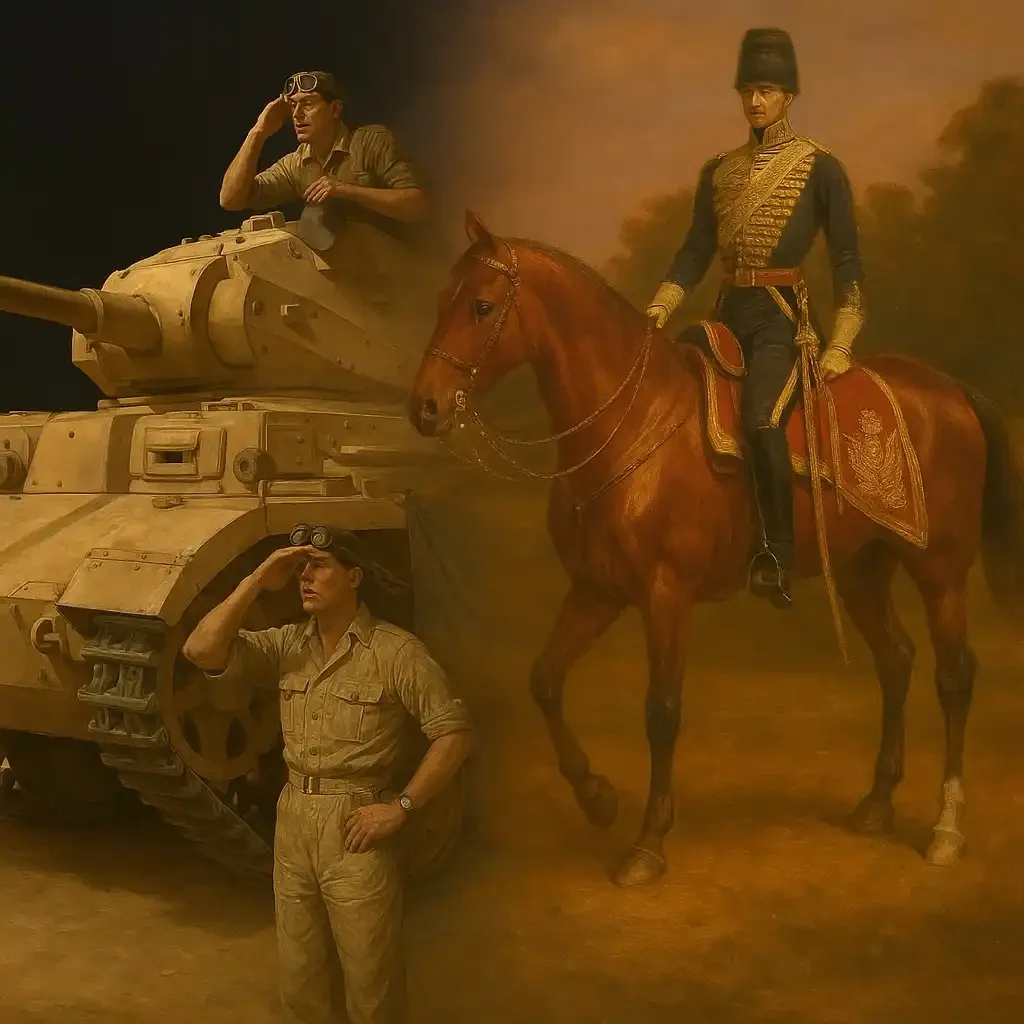
Tucked away in the heart of Gloucestershire lies a proud and enduring military story — one that begins with the gallop of cavalry horses and charges through the dust of desert warfare in mechanised tanks. This is the legacy of the Royal Gloucestershire Hussars (RGH), a regiment formed in 1795 that has served with distinction in every major British conflict since the 19th century. Their transformation from mounted volunteers to armoured warriors is not just a tale of military evolution, but a reflection of the adaptability and resilience that defines the soldiers of Gloucestershire.
Founding and Early Years: Citizen Soldiers on Horseback
 The RGH were established in response to the perceived threat of invasion during the French Revolutionary Wars. As part of a wave of volunteer cavalry regiments raised across Britain, they were composed primarily of yeomen — local landowners and farmers willing to defend their county and country. With their elaborate uniforms and finely bred horses, the Hussars were as much a social and ceremonial presence as they were a military one.
In these early years, the regiment embodied the values of loyalty, discipline, and county pride. They patrolled Gloucestershire, trained regularly, and stood ready to respond to internal unrest or foreign incursion. Their name — Hussars — reflected a European tradition of light cavalry renowned for their dash and fighting spirit.
The Second Boer War: First Combat Experience
At the turn of the 20th century, the Royal Gloucestershire Hussars received their first taste of real combat during the Second Boer War (1899–1902). Volunteers from the regiment joined the Imperial Yeomanry, serving in the rugged landscapes of South Africa where traditional cavalry charges were impractical and mobile skirmishes became the norm.
The campaign forced the regiment to adapt to new tactics and harsh conditions. They swapped dress uniforms for khaki and sabres for rifles, laying the groundwork for their future evolution. For many, the war underscored the importance of versatility and resourcefulness in modern warfare — qualities that would define the Hussars in the century to come.
World War I: The Gallant Cavalry of the Middle East
During the First World War, the Royal Gloucestershire Hussars were mobilised as part of the Territorial Force and initially deployed to Egypt. In the searing heat of the Middle Eastern theatre, they fought as traditional cavalry in the Sinai and Palestine campaigns, engaging Ottoman forces across vast desert landscapes.
Here, they played a vital role in key battles, including Gaza, Beersheba, and Jerusalem. Their ability to endure harsh climates, operate with limited supplies, and mount fast assaults across open terrain earned them widespread respect. In many ways, the RGH were among the last of the great cavalry regiments to see action on horseback.
Despite the increasing mechanisation of war on the Western Front, the Middle East allowed the cavalry to prove their worth one final time. The RGH maintained the romantic image of the mounted warrior — sabres drawn, banners flying — even as the world edged closer to the age of tanks and trench warfare.
World War II: Mechanisation and the Desert War
 The interwar years brought profound changes. The British Army restructured its forces, and cavalry regiments like the RGH began the transition from horse to machine. By the time World War II erupted, the Royal Gloucestershire Hussars had been re-formed as an armoured regiment, trading steeds for steel-clad vehicles.
Now equipped with Crusader and Sherman tanks, they played a critical role in the Western Desert Campaign of North Africa — a theatre that echoed the terrain and tactics of their First World War experience but demanded an entirely new set of skills. The RGH served under the 8th Army, famously nicknamed the “Desert Rats,” and took part in decisive actions including Operation Crusader and El Alamein.
Operating tanks in the desert posed extraordinary challenges: scorching temperatures, blinding sandstorms, mechanical breakdowns, and enemy ambushes. Yet the Hussars rose to the occasion. They used their cavalry instincts — speed, manoeuvrability, initiative — to outfight Rommel’s Afrika Korps, demonstrating that while the tools of war had changed, the spirit of the regiment had not.
Post-War Legacy and Modern Role
Following the war, the Royal Gloucestershire Hussars were reconstituted as part of the Royal Armoured Corps, continuing their service in various forms through the Cold War and into the modern era. In 1967, they became part of the Royal Wessex Yeomanry, a reserve regiment that continues to serve with the British Army today.
Though no longer a standalone unit, the RGH’s heritage lives on. They provide trained tank crews to regular armoured regiments, upholding their proud tradition of cavalry excellence and modern adaptability. The regiment’s motto — “Pro Aris et Focis” (“For Hearth and Home”) — still resonates in every soldier who carries the torch of the Gloucestershire Hussars.
Explore the Hussars’ Journey at the Soldiers of Gloucestershire Museum
For those wishing to trace the full arc of the Royal Gloucestershire Hussars’ transformation, the Soldiers of Gloucestershire Museum in Gloucester Docks offers an immersive and moving tribute. The museum’s dedicated exhibits bring their story vividly to life, from the gleaming dress uniforms of the 19th-century cavalry to the sand-scarred Crusader tank “Gypsy”, which stands as a striking centrepiece.
Visitors can discover personal letters, campaign maps, weapons, and uniforms — each artefact telling a piece of the Hussars’ evolving story. One moment you’re gazing at a finely embroidered cavalry saddlecloth; the next, you’re standing beneath the hulking barrel of a tank, imagining the roar of engines and the grit of desert combat.
The museum also honours the regiment’s role in community life, with photographs and oral histories detailing the connection between the RGH and the people of Gloucestershire. It’s a story of local pride, of sons and brothers who answered the call of duty — whether on horseback or behind armour plating.
A Lasting Legacy of Courage and Change
The journey of the Royal Gloucestershire Hussars from horseback to tank turret mirrors the broader transformation of warfare itself. What began as a volunteer cavalry riding through the hills of Gloucestershire ended up as an armoured force pushing through the deserts of North Africa. Throughout, the core values — bravery, adaptability, and devotion to duty — remained unchanged.
Their legacy is not just written in battle honours or regimental records. It lives on in the museum’s collections, in the landscape of Gloucestershire, and in the continued service of today’s Royal Wessex Yeomanry.
Visit Today and Discover Their Story
Experience the full legacy of the Royal Gloucestershire Hussars at the Soldiers of Gloucestershire Museum. Whether you’re a military enthusiast, local historian, or family visitor, the Hussars’ extraordinary tale of transformation is sure to inspire.
For more detailed background and historical accounts, visit the Wikipedia entry on the Royal Gloucestershire Hussars.