
The Gloucestershire Regiment: Triumph and Endurance on the Road to VJ Day (1944–1945)
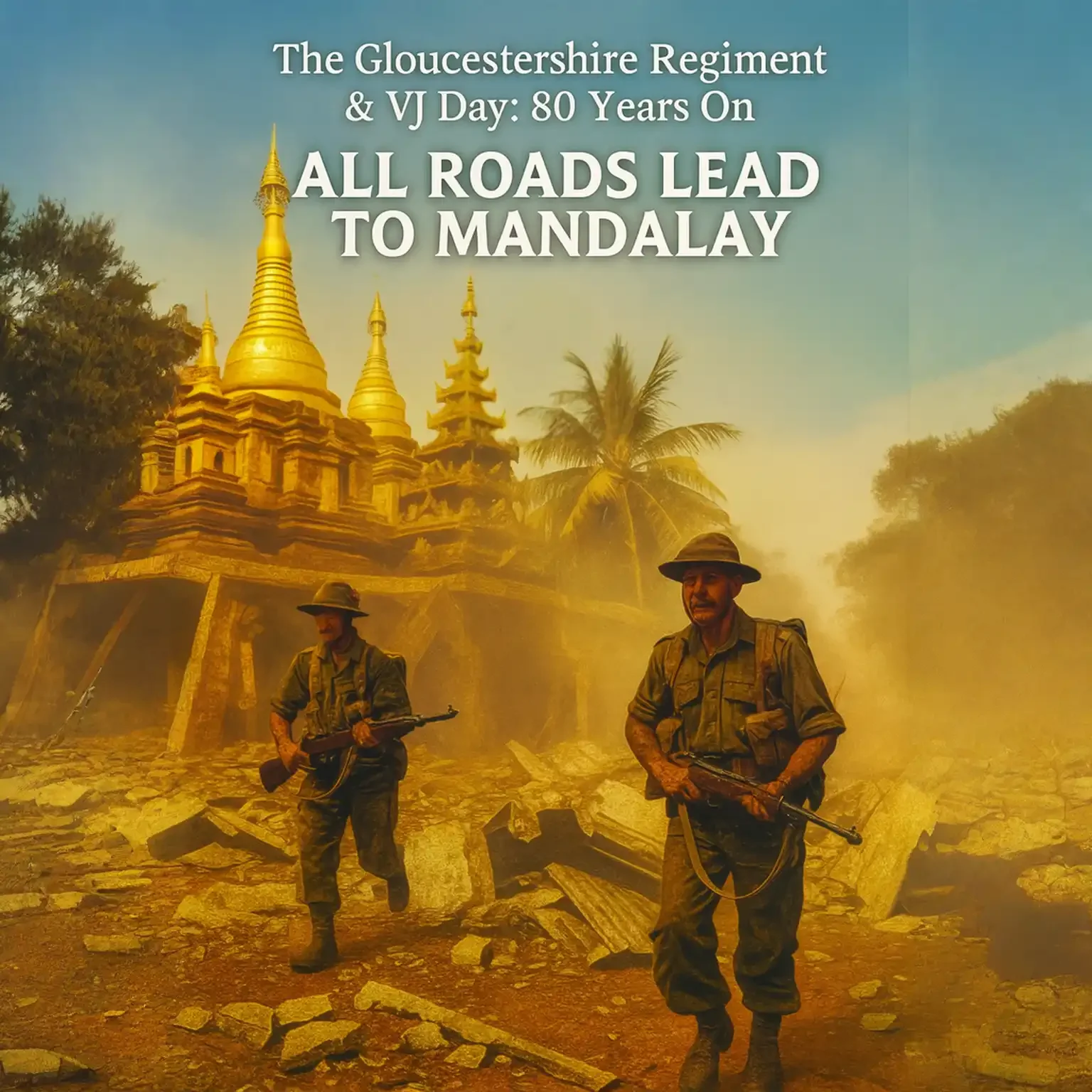
 As the world marks the 80th anniversary of Victory over Japan Day (VJ Day) in August 2025, we remember the extraordinary courage and endurance of those who fought in one of the most challenging theatres of the Second World War: the war in the Far East. While jubilant crowds celebrated VE Day on 8 May 1945, for soldiers in Burma and beyond, the war was far from over. Japan’s formal surrender came months later, on 15 August 1945, with the official signing aboard the USS Missouri on 2 September 1945.Among those who fought to secure this hard-won peace were the men of the Gloucestershire Regiment, whose tenacity and sacrifice helped turn the tide against Japan. Today, their story lives on, with artefacts from this campaign proudly displayed at the Soldiers of Gloucestershire Museum.
The Forgotten Front: A Brutal Campaign
The war against Japan began in December 1941, when Japanese forces swept through Malaya, Singapore, and Burma with alarming speed. Burma was strategically vital: a lifeline for China and a buffer protecting British India. Yet, the campaign was overshadowed by events in Europe and fought with limited resources against a determined enemy.For British and Commonwealth troops—including the Gloucesters—the conditions were punishing. They faced:
- Dense jungles, mountainous terrain, and monsoon flooding.
- Extreme heat, leeches, and rampant disease such as malaria and dysentery.
- Shortages of food, water, and ammunition, often far from supply lines.
This campaign earned the name “The Forgotten War”, but for those who endured it, it was unforgettable.
The Gloucesters in Burma: Courage Under Fire
By 1944, battalions of the Gloucestershire Regiment were heavily engaged in the Burma Campaign. The 10th Battalion, formed for wartime service, joined the 72nd Indian Infantry Brigade of the 36th Division. Initially trained as an armoured regiment, they were thrust into jungle warfare with little preparation—learning their craft “on campaign and on the field of battle, at great human cost”.The 1st Battalion, a regular unit, also played a vital role, acting as rearguard during the retreat to India and later in the reconquest of Burma.One rare insight into their reality comes from the 1944 film “Northern Burma: Advance on Pinwe”, showing the 10th Gloucesters hacking through jungle, supported by 25-pounder guns and US P-47 Thunderbolts. It even captures a somber burial service for a soldier killed by a Japanese grenade—a stark reminder of the human price of progress.
The Advance South and the Battle of Myitson
In late 1944, the 36th Division began its advance south toward Mandalay, pushing through the teak forests of northern Burma. The 10th Battalion engaged in a series of hard-fought skirmishes around Mabein before facing its greatest test: the Battle of Myitson in February 1945.Japanese forces aimed to destroy the 36th Division on the Shweli River. When the 26th Indian Brigade’s initial assault stalled, the 10th Gloucesters—reduced to barely 250 men—were sent in to reinforce the line. Fighting was fierce and confused, with jungle and tall elephant grass limiting visibility.“D” Company of the 10th Battalion was cut off for four days, surviving on scant supplies. Yet, they held firm, inflicting 40 Japanese casualties before being relieved. The battle climaxed on 17 February, with Japanese forces finally retreating.Victory came at a high cost: the 10th Battalion lost 2 officers and 117 men. Lance-Corporal Ronald Spreadbury recorded in his diary on 18 February:“Good news this morning, about 250 Japs killed in yesterday’s attack. Supplies are flown in, food and ammo were very short, all O.K. now. Plenty of aircraft about.”The aftermath saw bitter command disputes. Lieutenant-Colonel Richard Butler, commanding officer of the 10th Battalion, was dismissed after criticising senior leadership—a stark reminder that battles were fought both in the jungle and in the chain of command.
The Final Push and VJ Day
After Myitson, the Gloucesters pushed on to Mongmit, Mogok’s ruby mines, and finally Mandalay, airlifted there in April. In May 1945, the 10th Battalion withdrew to India as the war in Burma drew to a close.Then, in August 1945, came the news the world had long awaited. Japan surrendered following the atomic bombings of Hiroshima and Nagasaki. Spreadbury captured the mood:“Japs ask for peace. What news. We celebrate with the next three days off.”For many, VJ Day brought not wild jubilation but “quiet relief, exhaustion, and remembrance”. It marked liberation for thousands of prisoners of war and the end of a campaign where the Gloucesters had shown unyielding resolve.
Symbols of Triumph and Endurance
Among the most poignant relics of this campaign is a captured Japanese flag, taken at Taungye in 1944 by Corporal Bent, later photographed in the hands of Gloucestershire Regiment soldiers. Unlike flags waved on VE Day, this one symbolises a victory achieved through relentless struggle in the jungle rather than on European boulevards.You can see this flag and other remarkable artefacts—including uniforms, personal diaries, and photographs—on display at the Soldiers of Gloucestershire Museum. These items bear silent witness to the courage and sacrifice of those who served in the Far East.
Challenges of the Burma Campaign
The Gloucesters’ experience highlights the sheer complexity of the Burma Campaign. They faced:
- Unforgiving Terrain: Dense jungles, monsoon rains, mountainous passes, and searing heat.
- Rampant Disease: Malaria, dysentery, and heat exhaustion claimed many more casualties than bullets.
- Logistical Nightmares: Units often fought on minimal rations and ammunition, relying on risky air-drops for survival.
- Fierce Resistance: Japanese troops fought tenaciously, launching counter-attacks and sniper ambushes.
- Psychological Strain: With global attention focused on Europe, many soldiers felt forgotten—fueling the campaign’s enduring title: “The Forgotten War.”
For the Gloucesters, these challenges were met with resilience, improvisation, and a deep sense of duty.
Commemorating the 80th Anniversary
As we approach VJ Day 80 in 2025, we honour the Gloucesters’ role in achieving final victory. Their endurance in Burma reminds us that peace was won not in a single theatre, but through a truly global effort.To discover more about their remarkable story—and see original artefacts from this campaign—visit the Soldiers of Gloucestershire Museum in Gloucester Docks. Here, history comes alive, ensuring that the sacrifices of those who fought on the road to VJ Day will never be forgotten.