
The Formation of the Cheltenham Troop: Gloucestershire's Cavalry Legacy Begins
As the 18th century drew to a close, the world was being reshaped by revolution. Across the English Channel, France had been plunged into chaos following the French Revolution, and the rise of Napoleon Bonaparte brought with it the threat of military aggression on an unprecedented scale. In Britain, concern about the possibility of invasion led to a surge in patriotic volunteerism, and one of the clearest examples of local response to national and international danger was the formation of the Cheltenham Troop on 25 December 1795.
This small but historic cavalry unit would go on to form the nucleus of the Royal Gloucestershire Hussars, a regiment whose proud history continues to be commemorated today at the Soldiers of Gloucestershire Museum. You can also read more about the event in the museum’s official timeline: The Formation of the Cheltenham Troop.
The National Backdrop: Britain and the Revolutionary Wars
In the early 1790s, Britain was already under considerable strain. The country had become involved in the wars that followed the French Revolution and by 1794 was officially at war with France. The revolutionary government in Paris had not only executed their king and queen, but also sought to export revolutionary ideals through military expansion across Europe. These ambitions directly threatened Britain and her allies.In response to the risk of invasion, Prime Minister William Pitt the Younger presented to Parliament a plan to strengthen Britain's internal defences. Among several initiatives, Pitt proposed the formation of a domestic military force made up of civilians – men who would serve within their own counties, and who could only be called into national service in the event of a severe emergency. This initiative became the Yeomanry Cavalry.
Gloucestershire Answers the Call
One of the earliest and most notable responses to this plan came from Mr. Powell Snell, a well-known gentleman from Guiting Grange, near Northleach. Recognising both the seriousness of the national threat and the opportunity for local service, Snell wrote to the Lord-Lieutenant of Gloucestershire offering to raise a cavalry troop based in the Cheltenham area. His offer was welcomed and formally approved by the Secretary of State, and within months Snell had raised a full-strength troop of around sixty well-mounted men drawn from the town and surrounding countryside.The unit became known as the 1st or Cheltenham Troop of Gloucestershire Gentlemen and Yeomanry. It was the first Yeomanry unit raised in the county and marked the beginning of what would eventually become the Royal Gloucestershire Hussars – one of the most distinguished volunteer cavalry regiments in British military history.
Patriotic Duty and Cheltenham's Community
The creation of the Cheltenham Troop reflected not only national military policy but also the social dynamics of late 18th-century Cheltenham. At the time, Cheltenham was enjoying growing popularity as a fashionable spa town. It was frequented by aristocrats and gentry, many of whom had estates in the surrounding countryside. These were the very people called upon by Pitt's plan to form the Yeomanry: landowners, gentlemen farmers, and those of sufficient means to provide their own horses and uniforms.The troop's members were not career soldiers but citizens willing to put themselves forward to defend their community. Their patriotism and sense of civic responsibility formed the backbone of Britain's internal defences during a time when the fear of invasion was very real. In many ways, this local initiative exemplified the best of British values during a time of national uncertainty and unrest abroad.

The Cheltenham Troop Uniform
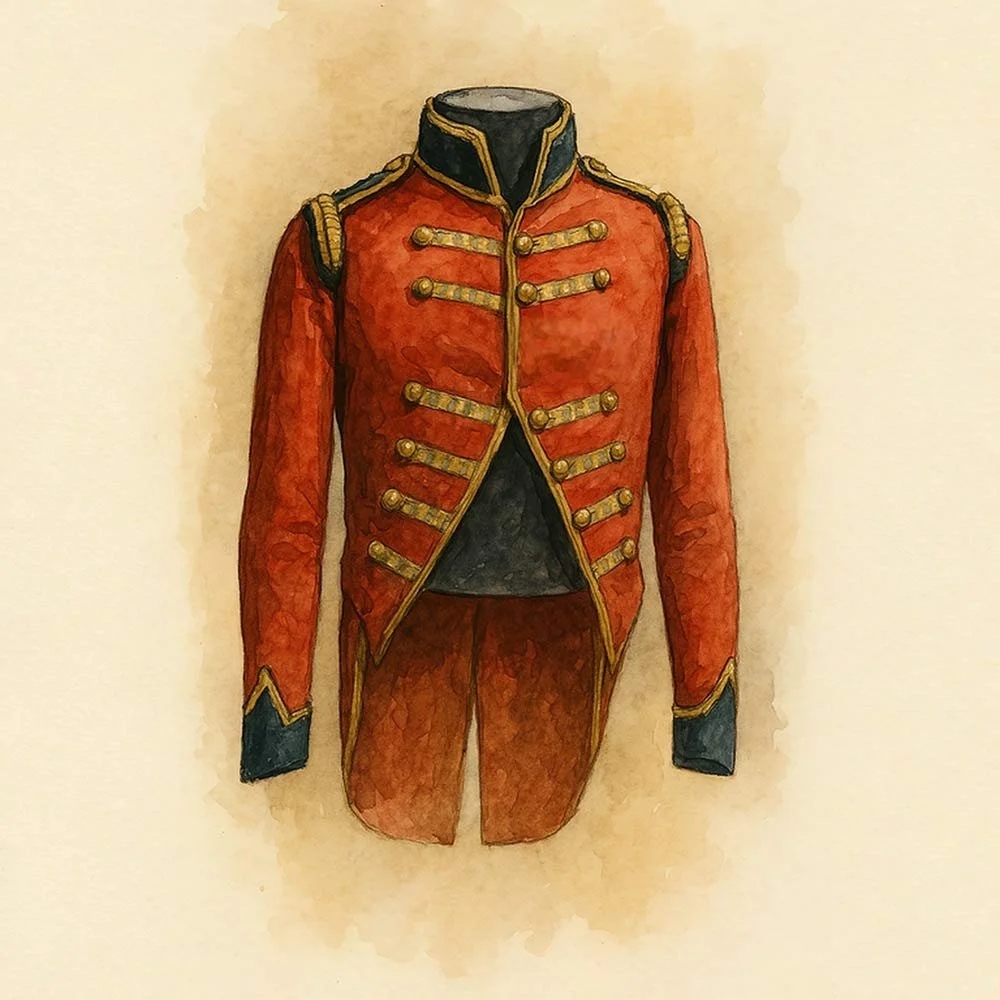
The Cheltenham Troop dressed in a uniform similar to that of the regular British Light Dragoons of the era. According to historical accounts:
- They wore a red jacket trimmed with white braid, which mirrored the style of the light cavalry of the time.
- White leather breeches and half-boots completed the lower half of the uniform.
- A sash and belt added formality and functionality to the ensemble.
- The troop wore a black leather helmet adorned with a red and white feather, offering both visual distinction and regimental pride.
This striking uniform helped to set the Yeomanry apart as a proud and professional-looking force. One excellent surviving example, the Cotswold Troop jacket from 1797, is on display at the Soldiers of Gloucestershire Museum and provides a tangible link to this formative period.
Local Response to International Tensions
Although the Cheltenham Troop was never called upon to face French forces directly, their very existence contributed to Britain’s wider strategy of deterrence and defence. The formation of similar troops across the country created a network of volunteers who could be mobilised in the event of civil unrest or invasion. For the people of Gloucestershire, the troop became a symbol of their commitment to national security and community resilience.In an era of global uncertainty, the British government relied on its people as much as it did on its professional army. The Cheltenham Troop served not only as a military unit but also as a model of how local initiative could bolster national efforts. The community spirit that led to its creation is something that still resonates today.
The Legacy of the Cheltenham Troop
The troop’s legacy did not end with the passing of the Revolutionary and Napoleonic Wars. Over the years, the unit evolved, merged, and was reorganised multiple times, eventually becoming the Royal Gloucestershire Hussars, a regiment that served with distinction in the Boer War, both World Wars, and continues to serve today as part of the Royal Wessex Yeomanry.The Cheltenham Troop’s DNA can still be found in the ethos of today’s British Army reserves: proud, community-based, and always ready to serve when called upon. It represents the birth of organised, volunteer-based cavalry in Gloucestershire, and its founding on Christmas Day 1795 remains a significant moment in local and national military history.
Visit the Museum
The story of the Cheltenham Troop and its transformation into the Royal Gloucestershire Hussars is just one of many remarkable narratives told at the Soldiers of Gloucestershire Museum. Located in the historic Gloucester Docks, the museum offers a compelling journey through 300 years of military history, from the earliest days of the Yeomanry through to modern-day service.Visitors can explore original uniforms, historical documents, and personal stories that bring Gloucestershire's military past to life. For anyone interested in how local history ties into global events, or how ordinary men became extraordinary soldiers, the museum provides an experience that is both educational and inspiring.
- Location: Soldiers of Gloucestershire Museum, Custom House, Gloucester Docks
- Website: soldiersofglos.com
- Explore more: Formation of the Cheltenham Troop Timeline Entry
Conclusion
The formation of the Cheltenham Troop in 1795 was a moment where local pride, national urgency, and global uncertainty intersected. It marked the beginning of a proud military tradition in Gloucestershire that still endures today. As international tensions rise and fall, stories like these remind us of the vital role played by everyday citizens who step forward in times of need.Come and explore this legacy at the Soldiers of Gloucestershire Museum and discover how Cheltenham helped defend a nation.