
Beyond VE Day: Remembering the End of the War in South East Asia
When the Celebrations Began — But the War Did Not End
On 8th May 1945, streets across Britain and Europe exploded in joy. Bunting flew, bells rang, and people danced in the streets. Victory in Europe Day—VE Day—marked the surrender of Nazi Germany and the end of the Second World War in Europe. Yet, for many soldiers serving in the Far East, there was no celebration. Their war continued.
As we approach the 80th anniversary of VE Day, it is important not only to reflect on the events in Europe but also to shine a light on the forgotten front—the brutal and unrelenting campaign in South East Asia, where British and Commonwealth troops, including men of the Gloucestershire Regiment, continued to fight until Victory over Japan Day (VJ Day) on 15th August 1945.
The War in the East: A Longer Road to Peace
The war against Japan had begun in December 1941, when Japanese forces attacked British and American territories across the Pacific and Asia. With a strategy built on swift occupation, Japan advanced rapidly, capturing Malaya, Singapore, Burma, and much of the Pacific.
This opened a new front for Allied forces. While attention and resources were focused on defeating Germany, the campaign in the East raged on with fewer resources, limited reinforcements, and incredibly harsh conditions. The terrain was unforgiving, with dense jungles, monsoon rains, mountainous passes, and disease running rampant. It was in this environment that British forces, including the Gloucestershire Regiment, were deployed.
The Gloucestershire Regiment in South East Asia
 Soldiers of the Gloucestershire Regiment saw action across the world during WWII, including in the North African desert, Italy, and later, the Far East. By 1944, several battalions were involved in the Burma Campaign, one of the longest and toughest campaigns of the war.
Burma was of enormous strategic value, acting as a buffer between British India and Japanese-occupied South East Asia. Japanese forces sought to isolate China from Allied support and to push into India. To stop them, Allied forces had to hold the line through a vast jungle frontier.
The Gloucesters were engaged in hard-fought actions alongside Indian, African, and other Commonwealth troops. The Chindits, a special force operating behind enemy lines, also played a crucial role in the region’s warfare. Conditions were extreme: soldiers had to contend not only with enemy fire but also with disease, heat exhaustion, leeches, and monsoon flooding.
Key Battles and Turning Points
Some of the most important and gruelling battles in this theatre include:
-
The Arakan Campaign (1943–44): A series of operations aimed at reclaiming coastal Burma. While early efforts struggled, later campaigns were more successful and marked a turning point in jungle warfare.
-
The Battle of Imphal and Kohima (March–July 1944): Often referred to as the “Stalingrad of the East”, these battles saw Japanese forces launch an invasion of India, only to be decisively defeated. The fighting was intense, with soldiers holding ground for weeks under siege, relying on airdrops for survival.
-
The Advance to Mandalay and Meiktila (1945): A coordinated push by Allied forces that ultimately broke the back of the Japanese army in Burma, forcing them into retreat.
Throughout these operations, Allied soldiers endured immense hardships, often fighting in remote areas cut off from supply lines. Victory came slowly, and at great human cost. Many soldiers felt forgotten by those at home, as headlines in the West focused largely on the European theatre.
The Human Cost and Spirit of Endurance
Soldiers in Burma and the wider South East Asian campaign faced unique and often underestimated challenges. Malaria, dysentery, trench foot, and heatstroke were rampant. Food and water were scarce, and ammunition was often limited.
Despite these adversities, morale remained remarkably high. There was a strong sense of purpose—knowing that success in the East was vital for ending the war globally. The resilience and fortitude of these men, many of whom had already served in other campaigns, was extraordinary.
Many of the personal stories, letters, and photographs of Gloucestershire Regiment soldiers from this time are preserved in the collections of the Soldiers of Gloucestershire Museum, offering poignant testimony to the hardships they endured and the friendships they forged.
A Captured Flag: A Symbol of Sacrifice and Triumph
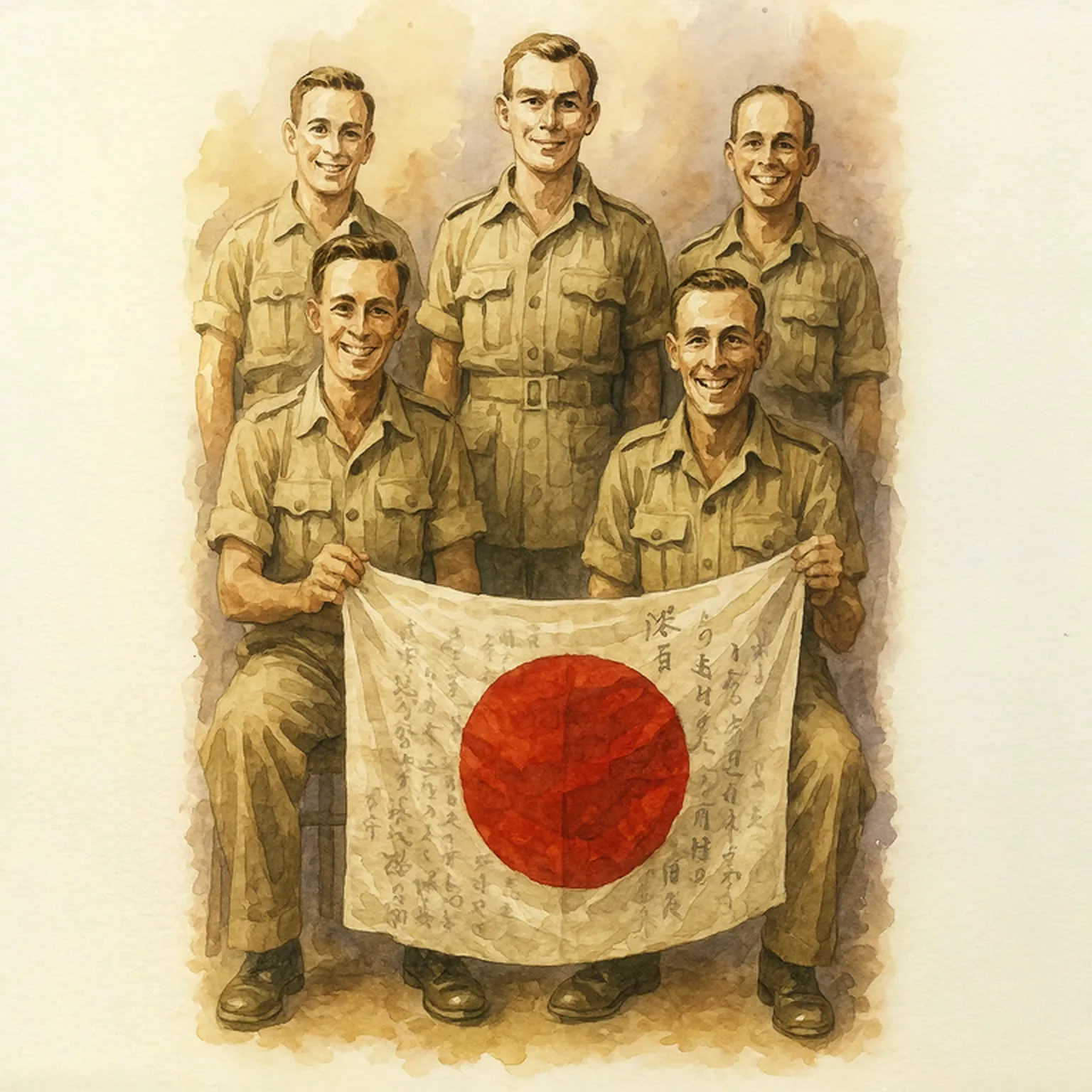
One such powerful symbol from the campaign is the captured Japanese flag taken at Taungye in 1944, held proudly by Gloucestershire Regiment soldiers in a well-known photograph taken in 1945. This image—now reimagined as a watercolour and pen-and-ink illustration—represents not only victory but also endurance, comradeship, and the deep toll the campaign took.
Unlike the flags raised in celebration on VE Day, this one was taken in silence, in the aftermath of grueling combat. It reminds us that peace was not won overnight—and not by one theatre alone.
VJ Day: The Final Victory
Japan’s surrender on 15th August 1945, following the atomic bombings of Hiroshima and Nagasaki, brought the Second World War to a close. For many soldiers, VJ Day was not one of jubilation but one of quiet relief, exhaustion, and remembrance.
Thousands of prisoners of war—many held in appalling conditions in camps across Asia—were finally liberated. Families received long-awaited letters. Survivors began the slow process of healing, both physical and emotional.
VJ Day was, and remains, a complex and deeply emotional milestone. It marked the end of a global war that had claimed tens of millions of lives and forever changed the world.
Looking Ahead: The 80th Anniversary of VJ Day
While VE Day 80 is rightly being marked with commemorations, exhibitions, and community events, we must also prepare to recognise the 80th anniversary of VJ Day in August 2025.
The Soldiers of Gloucestershire Museum will continue its commitment to sharing the stories of those who fought in South East Asia, ensuring their sacrifices are not overlooked. Upcoming events will explore the Far East campaign in greater detail, including:
-
Special exhibitions featuring artefacts, letters, and uniforms from the Burma campaign.
-
Talks and guided tours focused on the regiment’s role in South East Asia.
-
Commemorative digital content, including images and illustrations like the captured flag portrait.
Why This History Matters
The South East Asian campaign is sometimes known as “the Forgotten War,” overshadowed by the European and Pacific theatres. But for those who served in the jungles of Burma and beyond, it was no less intense, no less deadly, and no less heroic.
As we remember 80 years since the end of the war in Europe, we must also honour those whose fight continued beyond the headlines—those whose stories remind us that victory required a truly global effort.
Join the Commemoration
We invite everyone to reflect on the full story of the Second World War. Come and visit the Soldiers of Gloucestershire Museum to explore our growing archive, learn more about the Gloucestershire Regiment’s journey, and be part of our commemorative efforts leading up to VJ Day 80.
👉 Explore the end of the war in South East Asia
Lest We Forget
From the deserts of Egypt to the jungles of Burma, the Gloucestershire Regiment played a vital role in securing peace. Their courage in South East Asia reminds us that history is not just made in the headlines—but also in the hardest, most remote corners of the world.
Let us remember them, and all those who served, as we honour both VE Day and VJ Day in 2025.